

Translating for Aliens: Outpost of Jupiter / Story of Your Life
Speaking to non-human minds
“Put in opposition to ‘style,’ there is no such thing as ‘content.’” - Samuel Delany, “About 5,750 Words”
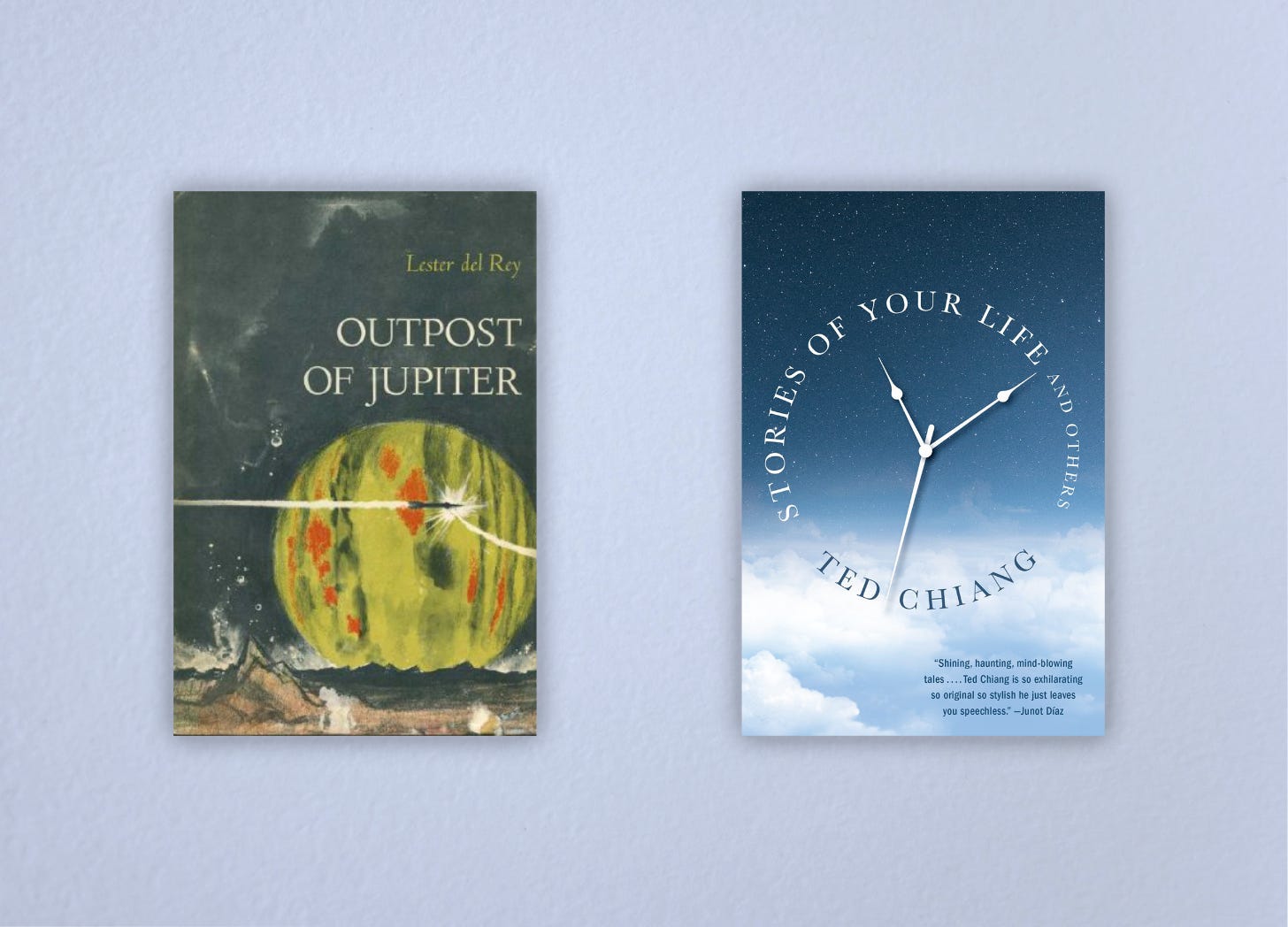
Outpost of Jupiter (Lester del Rey, 1963) is total pulp and I love it. I first encountered the book during a period of inhaling the SF section of my middle school library and read it over and over again that year. I am unsure why my library had this book at all; it was out of print at the time and never especially popular. Outpost is one of del Rey’s “juveniles”, a subgenre intended as edutainment for geeky boys. (And it was always boys, as a marketing category if not an actual readership.) The hero is Bob Wilson, a teenage linguistics student who ends up stuck at a frontier colony on Ganymede after a decline in his father’s health and finances prevents the family from returning to Earth. A first-contact story ensues in which Bob and aliens from Jupiter save each others’ lives when a plague breaks out.
Ted Chiang’s “Story of Your Life” (1998) has a very different publication history. The novella established Chiang as a titan of modern science fiction and was adapted into the film Arrival (2016). It has essentially the same premise as Outpost, in which the protagonist must learn to communicate in an alien language, but the emotional focus is completely different. The aliens are more of a frame story; the narrator becomes fluent in their language but never learns much about where they come from or what they want, and doesn’t seem especially disappointed by this. Instead, the new language radically restructures her mind and consciousness, such that she can remember her unborn daughter’s entire future life simultaneously. The narration jumps across time periods to devastating effect. “Yes, that’s her. She’s mine,” the narrator repeats at turning points, once identifying a young woman’s body in a morgue, once identifying a newborn in a maternity ward.
I don’t want to overstate the formal strangeness of “Story of Your Life,” because Chiang is pulling a kind of sleight of hand. There were much weirder formats available to really emphasize arbitrariness of grammar and nonlinearity of time, like Oulipo poet Raymond Queneau’s One Hundred Thousand Billion Poems (1961), which consists of sonnets cut into horizontal strips such that they can be flipped through and recombined. “Story of Your Life” is not an Oulipo experiment. The internal chronology is nonlinear, but the plot structure is recognizable. There’s a hook, a romance arc, a science fictional mystery, and a dénouement. The phenomenology of time is used to establish a focus on a specific mother-daughter relationship.
In that way, both stories are pushing up against a very difficult problem central to their genre, that of representing an alien consciousness while still producing a readable text. “How could a human being imagine what would be trouble to a non-human?” Bob Wilson wonders. Outpost of Jupiter answers that the fear of disease and death are universal to all creatures that can suffer illness, and this shared problem becomes the source of shared understanding. (As a side note, this hits differently rereading it after COVID-19.) In “Story of Your Life” the researchers completely fail to discover what troubles or interests the aliens. “We never did learn why the heptapods left, any more than we learned what brought them here, or why they acted the way they did.” I go back and forth on whether this is an indication of realism or a lack of commitment to alien characters.
Both stories are also working within the constraint of having been written in English specifically, which both acknowledge but don’t fully examine. Much of the effect of “Story of Your Life” comes from its work with tense. “I remember what it’ll be like watching you when you are a day old,” the narrator says of her daughter, using several different verb forms which are perfectly comprehensible but not usually found in the same sentence. The effect relies on the importance English places on tense: English verb forms almost always encode tense, can encode very specific variants of tense, and encode very little other than tense. The story would not read as naturally in Russian, where the most important thing about a verb is its aspect (perfective versus imperfective, that is to say the distinction between a completed action and an ongoing or habitual one). Let alone in Japanese, where verb suffixes can specify social information but the difference between present and future tense is left to context.
I find this pairing useful for thinking about the term “literary” as applied to SF, because both works are part of the same lineage of first contact narratives but “Story of Your Life” is taught in literature courses and Outpost of Jupiter very much is not. Take pixel art as an analogy. There are various definitions in use—all digital art is composed of pixels, and pixel art can vary wildly in style and production technique—but one I favor is that pixel art is any digital art in which the creator deliberately exerts control over the composition at the level of individual pixels. When I refer to literary sci-fi, I mean works in which the author’s stylistic flourishes at the word and sentence level are a significant part of the reading experience. “Story of Your Life” begins, “Your father is about to ask me the question.” The second person is a noticeable choice. So is the present tense, already nonstandard, but with evident knowledge of the future. It’s unclear if this is time travel, memory, or something else. Receiving the full effect of the story requires linguistic attention from the very first line.
In the pulp tradition, the prose of Outpost of Jupiter is almost aggressively unadorned. Even a frightening alien craft gets about two sentences of description. “Out in space, behind the Procyon was a strange globe of white. As it rushed up, it seemed to be about three hundred feet in diameter, with no features on the outside.” The priority is communicating the minimum information necessary for the plot to advance. This is partially the constraint that del Rey was writing very quickly for a young audience, but also an almost philosophical preference for unambiguity, which the text itself says outright: “Somehow, there should be a possible language that would be so logical that it was almost self-evident and perfect for computers, but still so rich that it could express all the wonder and poetry men alone could feel.” English does not seem to be doing the trick.
Now I really want to read "Story of Your Life." Thank you for suggesting it!