

The Deep Fovea: The Peregrine / No One Is Talking About This
The poetics of attention
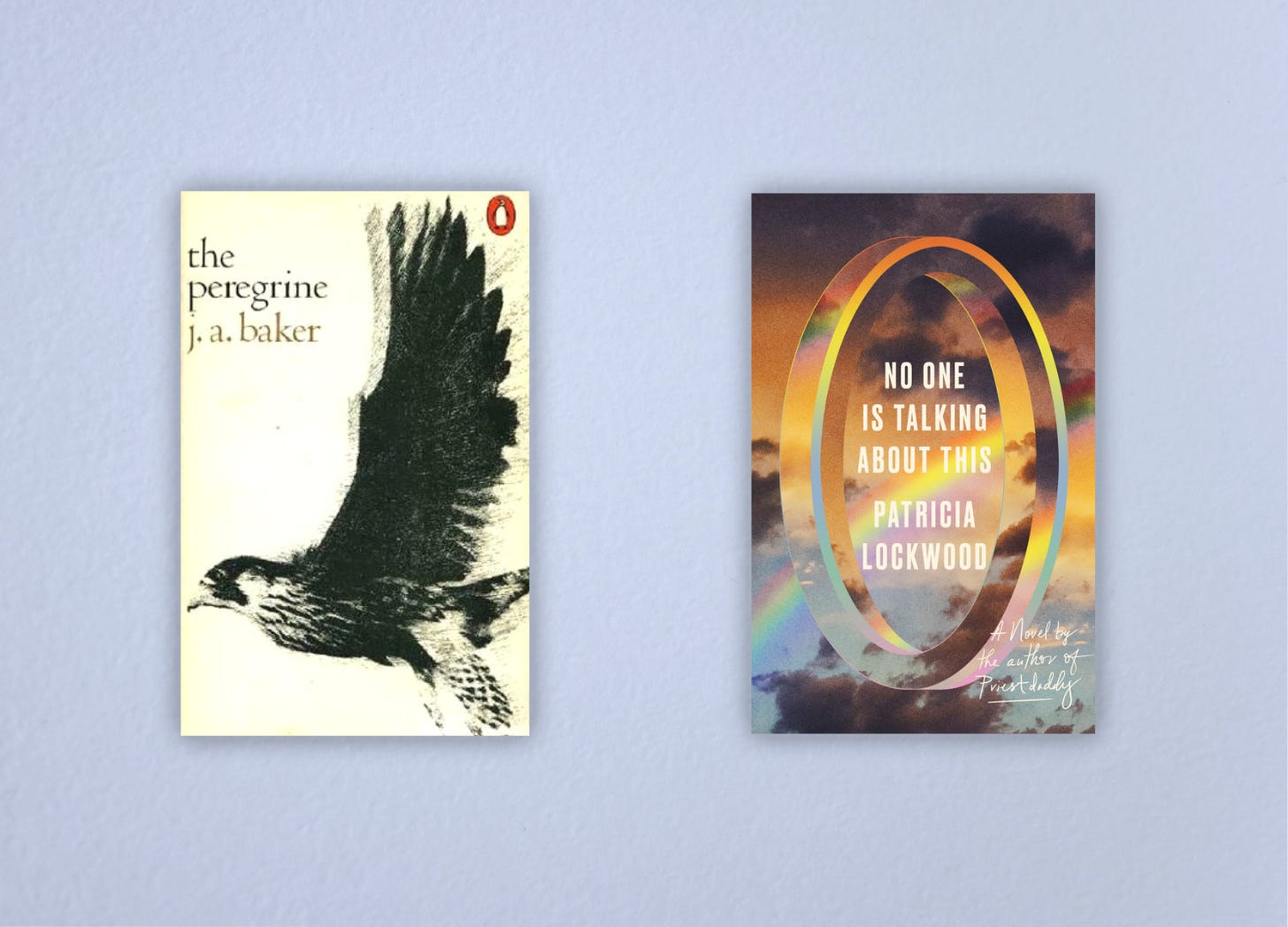
The Peregrine (J.A. Baker, 1967) and No One Is Talking About This (Patricia Lockwood, 2021) are two books about watching something carefully for a long time. The word “focus” in a generic sense usually makes me think of academia, or maybe the type of wellness culture that involves a lot of candles. These books have a focus in the sense of photography or ophthalmology: a point at which light converges, a point which receives complete attention until everything outside of it blurs into the background. Both are short, almost 200 pages exactly, and would be exhausting at any greater length.
The Peregrine is about Baker’s observation of peregrine falcons, which sounds innocently pastoral enough until you remember that the peregrine is a bird of prey, which means that most of the book is a grimly detailed account of how peregrines hunt and kill other birds. Sometimes Baker records this with a technical critique as if he were the peregrine’s military advisor, sometimes with a tone of shocked surprise: “Their rapid, shifting, dancing motion had been so deft and graceful that it was difficult to believe that hunger was the cause of it and death the end.” The first half of No One Is Talking About This is about the current-events segment of the Internet in all its obscenity and mundanity. The second half is about a dying infant, and the juxtaposition is the point.
If the two books share a formal concern it is something like total commitment to accurately representing an experience even if that requires inventing a new genre to do it in. The Peregrine is a diary, rewritten for publication, of a single winter spent traipsing across maybe twenty square miles of Essex marsh watching a couple of mated pairs of peregrines. Baker gives charts and numerical observations that belong in a field guide, and then you get phrases like “the shaken kaleidoscope of colour that stains the deep fovea of his brilliant eye.” It’s like an academic monograph as written by a Symbolist poet. Nature writing as a genre had already been well established by writers like Aldo Leopold and Rachel Carson, but The Peregrine is distinguished by its attitude to its subject. Baker makes no move to establish a persona either as a folksy animal lover or as a birding authority. He mentions exactly twice that peregrines are in decline due to pesticide use and then makes no call to action. Even the place names are stripped from the material, becoming just “the brook,” “the orchard.” The outside world barely exists, and the physical particulars of a peregrine in flight are everything.
No One Is Talking About This is closer to straight verse. Lockwood writes with the air of someone who has been a poet for long enough that normal syntax has stopped having the same kind of claim on her it has on other people, like the astronauts who serve on the ISS for so long they forget about gravity. On top of that the book is written in a stream of fragmented consciousness. No One Is Talking About This will go on about obfuscated celebrity drama to the point of boredom and then occasionally deploy a luminous sentence to bring the reader back in: “She was an instantaneous citizen of the flash of lightning that wrote across the sky I know.”
I’m reminded of another piece of Lockwood’s writing, the essay “Insane after coronavirus?” (2020), about being seriously ill with COVID-19 before vaccines were available. She says of her husband, “it turned out that he was also delirious and had been playing the same twenty minutes of Skyrim over and over without ever progressing. When he checked later he saw he had saved 130 games, and that all of the characters he had so painstakingly created had ripped abs, leather outfits and huge cat heads.” The Internet as depicted in No One Is Talking About This has that same kind of febrile, vaguely erotic logic. “The mind we were in was obsessive, perseverant.” Nothing is allowed to linger past a news cycle but nothing is allowed to completely end either. Then the narrative pivots hard when the narrator’s niece is born with a fatal genetic condition, which becomes an event too urgent to allow continued participation in everyday life and too singular to explain to anyone else, a “great gap in the thrumming of the knowing of the news.” The book continues to be a series of lyric snippets, now not because the narrator cannot sustain a thought but to express the condition of time spent with a child whose lifespan will be short but indeterminate. The ending is obvious and moving and seems to be based on actual experiences of Lockwood’s family. Without the Internet-drenched first half, the book would be a grief narrative of a legible type. With the first section it is something stranger.
Where I struggle with No One Is Talking About This is that I don’t find the crude and orthogonal humor here funny, though Lockwood’s memoir Priestdaddy (2017) had me laughing constantly. A joke about an incestuous instant coffee commercial can be amusing; a joke about strangers’ jokes about the commercial, reported years after the fact, has a taxidermic quality. It’s possible it’s not supposed to be funny, or at least that the narrative function can survive without the humor. The idea that the phrase “can a dog be twins” could gain worldwide renown doesn’t have to be funny to be accurate.
The Peregrine doesn’t have tone problems. The attitude of respectful attention remains the same the whole way through. It’s repetitive without feeling so, because each day’s weather and each flight’s outcome are narrated with the specificity of a war correspondent reporting from the front: “Godwit and peregrine darting, dodging; stitching land and water with flickering shuttle. Godwit climbing, dwindling, tiny, gone; peregrine diving, perching, panting, beaten.” The prose is so dense and rich I could only read a chapter or so of it a day. The text slips between past and present tense apparently at whim. Once or twice it slips, unnervingly, into the voice of a falcon. “We shun men.” There is no narrative arc. Peregrines do not know about narrative arcs.
It’s too easy of a conclusion to say that any topic can be interesting if it’s written about attentively. (I have tried and failed to read Mark Kurlansky’s history of the codfish.) Global movements are interesting by sheer scale. Families are interesting. Violence is almost always interesting even when it’s sad or gruesome, because the stakes are obvious and inherent. Lockwood and Baker have landed on subjects which are compelling if occasionally unpleasant. Or maybe they just couldn’t turn away from the subjects. Baker says, “For ten years I followed the peregrine. I was possessed by it. It was a grail to me.” Grails are rare enough that someone else’s is usually worth observing.