

Speaking the Name: Maurice / Brideshead Revisited
To a happier year
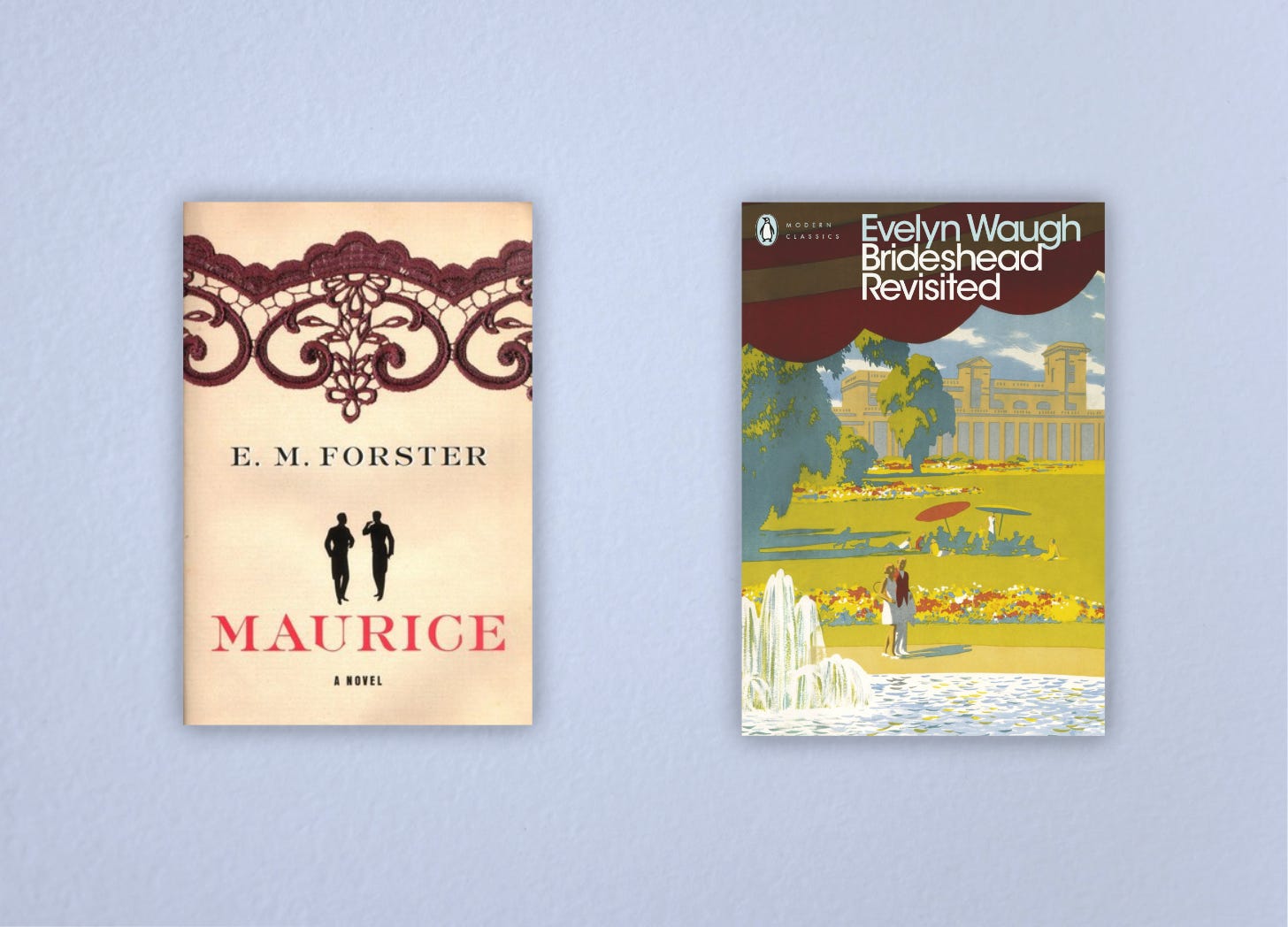
Maurice (E.M. Forster, written 1913-14, published 1971) and Brideshead Revisited (Evelyn Waugh, 1945, revised 1959) are both among the great 20th-century novels of British gay life. But although they may be in the same tradition, they do not advance the same project. Near the beginning of World War I, Forster wrote a queer romance novel which is also a class critique, passed it around a limited circle, and did not seek publication during his lifetime. In the middle of World War II, Waugh took leave from his unit to write a queer tragedy which is also a Catholic apologia.
Maurice and Brideshead are most alike in their early sections, in which the protagonists fall in love with beautiful young men at their Oxbridge colleges, which was already practically a subgenre by 1945. The homosexual theme was a live one for both authors; Forster was as gay as he could be without actually getting arrested, and Waugh would have been familiar with love affairs between men at the very least through his brother Alec, who caused a scandal first by being asked to leave his secondary school because of a relationship with another student and then by writing a novel about it, The Loom of Youth (1917).
The arc is a near-formula: the university as an isolated world, the fascination with a particular man, the development of a relationship which is romantic and emotionally intense but plausibly non-sexual. A side character in Brideshead names the trope exactly: “I know of these romantic friendships of the English and the Germans… I think they are very good if they do not go on for too long.” The young Charles Ryder and the object of his affections, dissolute, “epicene” Lord Sebastian Flyte, are flirting with what music scholar Steven Soebbing called “the fine line of friendship”: the idea—common in Europe as early as Mozart’s Apollo et Hyacinthus (1767) and bizarre to modern minds—that boys often developed homoerotic attachments to each other, and also that this was a practice run or developmental stage that in a healthy psyche would naturally transition into heterosexual attachments. Brideshead is taking part in a centuries-old conversation about the boundaries of such relationships when it has Charles lose contact with Sebastian, fall in love with Sebastian’s (married) sister Julia, and say in a gloriously gender-bendy passage: “I had not forgotten Sebastian. He was with me daily in Julia; or rather, it was Julia I had known in him, in those distant Arcadian days.”
Maurice gestures at this conversation and then firmly declines to participate. Maurice’s first relationship ends when his partner grows distant from him and develops an interest in women instead. So far so traditional. But Forster refuses to send his protagonist down that same path. Maurice is often a muddle-headed person, but he decides early on that “He would not—and this was the test—pretend to care about women when the only sex that attracted him was his own.” Maurice is not a bildungsroman about a man finding his place in society. It is a genre romance, a very early gay example of the type, about a protagonist learning to be true to himself at significant cost and eventually being rewarded with true love. With Maurice’s eventual swift and intense courtship of a gamekeeper, Alec Scudders, Forster almost delightedly breaks every acceptable bound of “romantic friendships”—that they should be between men of the upper classes, that they should be chaste or at least never openly admit to sex, that they should not lead to a longer commitment or to sacrifice of conventional opportunities. Maurice gets in a good retort to his ex-lover who is appalled by Maurice’s lack of propriety with Alec: “You don’t worry whether your relation with [your wife] is platonic or not, you only know it’s big enough to hang a life on.”
Brideshead Revisited is probably the better novel from a craft perspective. Waugh was a magnificent stylist if nothing else. The scene that gives the book its title, when Charles Ryder sees the Brideshead estate again, establishes the narrative’s tone of elegiac beauty and nostalgia for a certain type of upper-class culture: “The woods were all of oak and beech… they made a simple, carefully-designed pattern with the green glades and the wide green spaces—Did the fallow deer graze here still?—and, lest the eye wander aimlessly, a Doric temple stood by the water’s edge, and an ivy-grown arch spanned the lowest of the connecting weirs. All this had been planned and planted a century and a half ago so that, at about this date, it might be seen in its maturity. From where I stood the house was hidden by a green spur, but I knew well how and where it lay, couched among the lime trees like a hind in the bracken.” In comparison Maurice has uneven pacing and occasionally reads like a not-quite-finished draft, as in one scene that simply begins “Episode of Gladys Olcott,” like a note to self that was left in. On that note, Maurice also has no interesting female characters whatsoever, although Forster was capable of writing women well, as in A Room With a View (1908).
In context I see these not so much as unintentional flaws as the fingerprints of a passion project in which Forster deliberately abandoned the self-censorship and technical control necessary for traditional publication. Forster says in an illuminating afterword that “a happy ending was imperative.” Almost every element in the novel is visible as working toward this ending by helping or hindering Maurice’s capacity for love and self-knowledge in a series of try-fail cycles. Whereas everything in Brideshead leads gradually to Charles’ conversion to Catholicism by continually entangling him with an emotionally complicated Catholic family.
That leads us to the books’ central ideological disagreement, over the nature of Christianity. Both agree that the Christian religion is incompatible with certain types of love (i.e., between men, between divorcés), and they fundamentally differ on how to respond. Brideshead treats Charles’ unacceptable loves as a wistful but necessary sacrifice for the sake of his soul. His conversion is described as an avalanche that cannot be resisted, which is a romantic image that destroys romance. Charles and both siblings he loves are all obliged to abnegate themselves and suffer quietly, like saints. In Brideshead, Christianity is deadly serious.
In Maurice, Christianity is essentially absurd. Maurice’s grandfather develops an eccentric belief that God dwells physically inside the Sun and condemned souls are cast out to the outer planets until Judgment Day. The implication is that this is not actually more outré than less heretical forms of the religion. Even more pointedly, Forster suggests that no self-respecting homosexual can be a practicing Christian: “Between [a young queer character’s] temperament and that religion there is a secular feud. No clear-headed man can combine them.” Christianity, and in particular a sort of self-satisfied Anglicanism, is one of the retrograde conventions the novel suggests need to be let go of before a person can identify real morality and happiness.
Brideshead Revisited was a nostalgic time capsule at publication and now carries an odd double-layered effect of looking back at one period looking back at another. Maurice is a fascinating period piece, a rare item of Edwardian fiction that is able to clearly and specifically name queer life as a topic. But Forster’s novel looks forward where Waugh looks back. Maurice is famously dedicated “to a Happier Year.” I was raised in a town that until the late 2010s had laws on the books that forbade teachers from discussing homosexuality in a positive light. Many happier years have come since 1914. I am still waiting for one that earns the dedication.
Great essay, thanks for sharing! (I even learned a new word, "outré")
Great essay.
"Maurice" is one of my favorite books.
You might be interested in my review of William di Canzio's "Alec" which is a re-imagining of the story from Alec's perspective.
https://kabiraltaf.substack.com/p/review-alec-by-william-di-canzio