

Sonnets Under Pressure: Love Letter from an Impossible Land / Fatal Interview
Queer formal poets seize the day
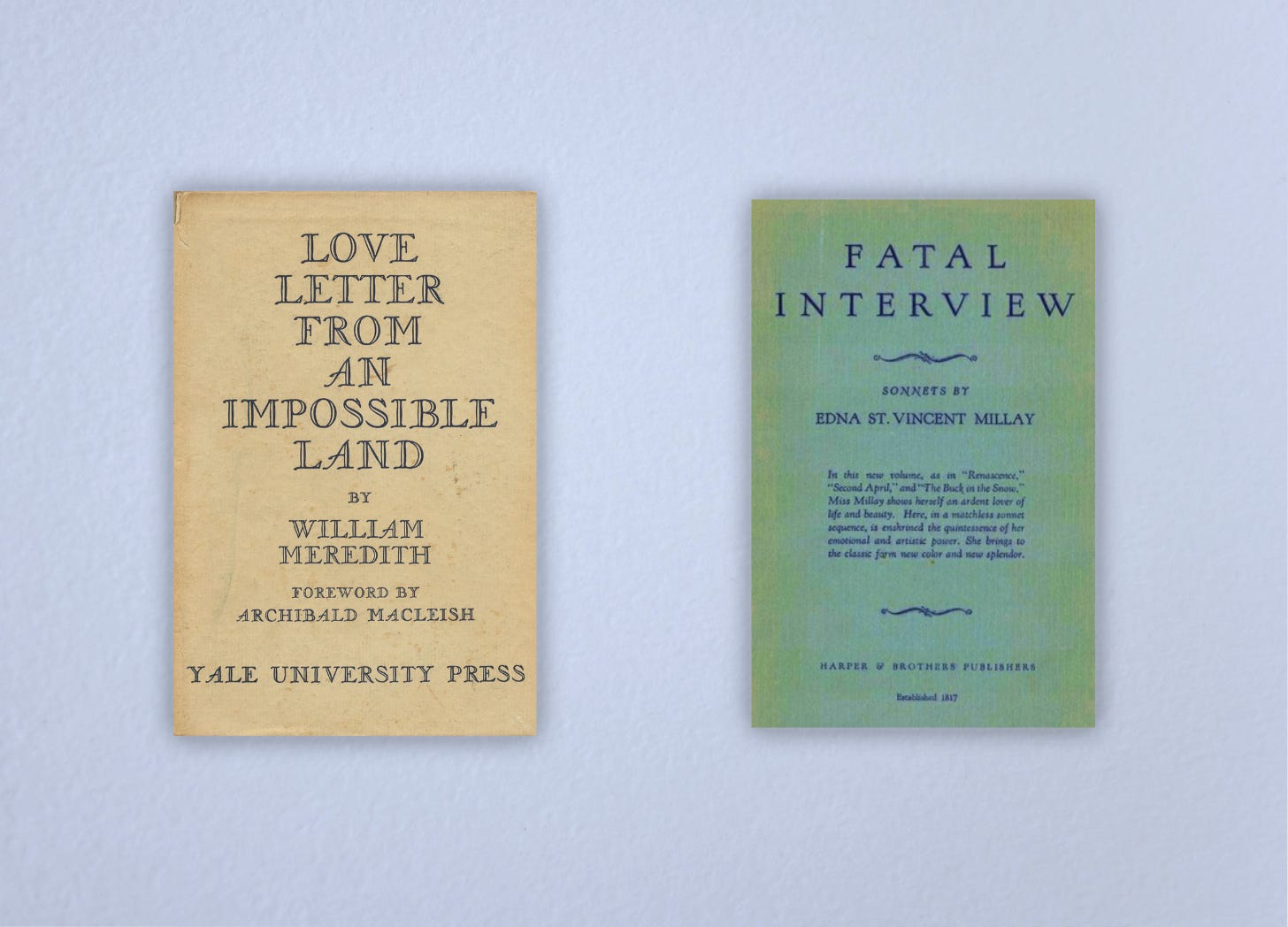
William Meredith is now best known for his late work, such as Effort At Speech (1997), which was written after years of rehabilitation for stroke-induced aphasia. By the end of his life, Meredith had been US Poet Laureate, won the Pulitzer, and publicly disclosed his long relationship with his partner, writer Richard Harteis. In 1944 none of this was yet true. Meredith’s first poetry collection, Love Letter from an Impossible Land, was published while the author was serving as a naval pilot in the Aleutians. Homosexuality was, of course, an offense punishable by court-martial. He had multiple reasons to describe love as an “impossible land”.
As a rule, the poems of Love Letter from an Impossible Land are short, in something like blank verse, and polysyllabic in a way that suggests a classical education. Many, unsurprisingly, are about war and piloting, but the tone mostly lacks triumph or despair or eulogy, even in the verse dedicated to a specific late comrade, Stratton Christensen. Meredith’s native register seems to be melancholic observation. From the titular poem:
“And stiff on the apron are the pretty planes
That waddle to the water and drum away,
Leaving me stammerer, inept to say
Why in their simple duty there is pain.”
Emotion is present but compressed. Reviewer Richard Ludwig said in 1963 that “Meredith will always sacrifice the flux of images and memories to their tight, even austere, control.” The poems come across as earnest but unwilling to overexplain. For me the key that unlocks this collection is the sonnet “Words After Midnight, Forbidding Remorse,” which is both an excellent read and a remarkable coded artifact.
Do not say to the gay game nay now lover
Under cover of love enough; does puritan twinge
Predict, against respite from passion, real change?
No, we shall want again later and greatly all over.
If the angular sky was not fashioned to conform
To these warm doings, then the stars there err,
For this is our way always; therefore have care
That no third sleeper come to our bed bringing harm:
Forbid Fear, whether his face be righteous as this is
And his talk scriptural of ultimate places,
Or whether he wear rather War’s unfeatured face
Who sleeps out nightly now and seduces
Many men and innocent women in their beds;
Say always to strangers that I am all your needs.
It’s a carpe diem poem (a form encouraging urgency to a lover; think Andrew Marvell’s “To His Coy Mistress”) but in a queer mode. The adjective “gay” in the 40s meant both “playful” and “lewd” but may have already been in use to refer to homosexuality in certain circles. The speaker and recipient are both of unspecified gender, which in English sonnets is perfectly traditional and also has been used to convey bisexual vibes since Shakespeare. The poem as a whole balances between tradition and modernity. The sonnet is the most respectable form in English love poetry, but this one is loose in rhyme and meter, almost concealing its sonnet nature. The syntax is playfully twisted in a way that invites rereading.
Most carpe diem poems cite natural or biological processes of age and death as the threats to love. “The grave’s a fine and private place / But none, I think, do there embrace,” Marvell says. In “Words After Midnight” love is under attack by human forces. The speaker urges a united front against church and state both, Fear in his twin guises of “talk scriptural” and “War’s unfeatured face”. The effect is desperate but also astonishingly bold. When the speaker says “the stars there err,” I have to assume the nod to and contradiction of Julius Caesar is deliberate (“The fault, dear Brutus, is not in our stars / But in ourselves”). If tradition or even fate cannot accept this relationship—and specifically its physical aspect—then tradition and fate are wrong. I keep being surprised that this was published by a closeted man in the midst of World War II.
And then there's Millay, whose sonnets are about as far from Meredith’s as possible while being in the same form with the same set of English and Greek canonical references. Edna St. Vincent Millay was more or less openly bisexual and a glamorous figure in interwar New York. Her sonnet cycle Fatal Interview (1931) was written in response to a relationship she had with a younger man, one which both Millay’s husband and her general social circle were aware of. Where Love Letter from an Impossible Land is guarded, Fatal Interview is transparent. Publishing the book was not a subtle act, and yet the poems are so intense, formal, and classical that they reveal very little biographical detail. The title quotes one of Donne’s elegies: “By our first strange and fatal interview…” The allusion is grim and centuries old.
The cycle is chock full of carpe diem poems. In Sonnet VIII, Millay’s speaker violently inverts sexual invitation into threat:
"Yet in an hour to come, disdainful dust,
You shall be bowed and brought to bed with me.
While the blood roars, or when the blood is rust
About a broken engine, this shall be."
The meter here is strict and martial, the iambs falling like hammer blows. The tomb is presented as an ultimatum, not a tragedy. “When the blood is rust / About a broken engine” is a very metal way to describe death. I don’t usually expect mechanical metaphors from Millay, who more often turns to mythology or animals. It makes an impact.
Fatal Interview is not so much about romance as about obsession, loss, passion in the religious sense. In the opening poems metaphors of wounds and fevers are constant. Love is a “sick disorder” (Sonnet IV), a “knotted hurt” (Sonnet II). The book models obsession on multiple levels. Publishing a collection of exactly fifty-two strict sonnets, nearly all of which reference death at least once, is not a normal or moderate response to the end of a love affair. It is a deliberately excessive, ecstatic gesture, as is each of the sonnets individually, creating a fractal of romantic agony. While these particular sonnets record a heterosexual relationship, their focus on a brief and consuming experience is one that is common in queer poetry. There’s nothing here about, say, marriage or society. The primary interest is desire itself, beyond specific conditions or a specific beloved, a sensibility which is readable as Sapphic. The volume of emotion is uncomfortable, it is unproductive, it is not socially welcome, and it is present anyway.
Sonnet XXIX finally provides a carpe diem in the classic mode. The speaker here is less cruel but still manic in tone. “Heart, have no pity on this house of bone: / Shake it with dancing, break it down with joy.” The impulse to delight seems inseparable from the impulse to self-destruction. Then the voice turns and announces its own genre directly:
“All that delightful youth forbears to spend
Molestful age inherits, and the ground
Will have us; therefore, while we’re young, my friend—
The Latin’s vulgar, but the advice is sound.
Youth, have no pity; leave no farthing here
For age to invest in compromise and fear.”
The later sonnets in the collection are painfully self-aware, still obsessed but clear-eyed about it. The most famous item in the work is Sonnet XXX, better known by its opening words, “Love is not all,” which is a surprising admission for any love poem and especially for a collection that is otherwise feverishly devoted.
Another intense queer American poet, Emily Dickinson, wrote, “That Love is all there is, / Is all we know of Love; / It is enough, the freight should be / Proportioned to the groove.” Meredith and Millay both chose the sonnet as a vehicle strong enough to bear their freight. The brevity and restraint of the form served their efforts to dial in exactly which emotions to display and which to conceal. A sonnet is at once an addition to a conversation, a creative limitation, and a container for barely speakable passions.
Thanks for covering one of my favorite poets, Edna St. Vincent Millay! I adore the paradox in "Love is Not All."