

Source Code: The Once and Future King / The Owl Service
Retellings that show the seams
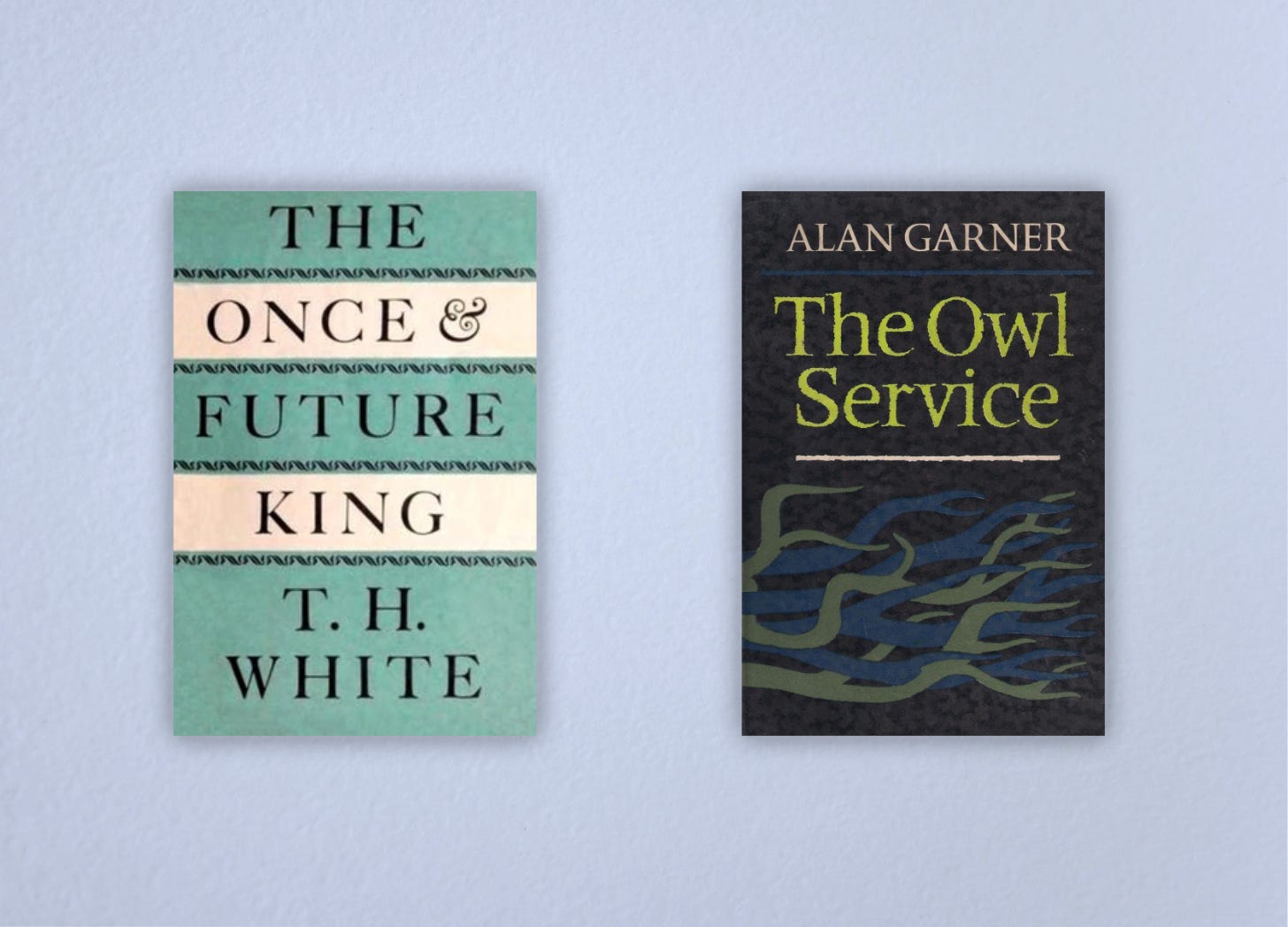
This grouping is less a pair and more a quartet of books in conversation with each other. The Once and Future King (T.H. White, 1958) and The Owl Service (Alan Garner, 1967) are both retellings of British myth; in particular, they are reinterpretations that openly and constantly refer back to specific source material. The newer authors want you to read the older ones. The Once and Future King is explicitly an update of Le Morte d’Arthur (Thomas Malory, 1485), which was itself compiled from various earlier English and French sources. White updates the language, focuses on his personal interests, adds large quantities of his own cheerfully anachronistic material, but always keeps one eye on Malory. The Owl Service retells the legend of the magically-created woman Blodeuwedd, whose tragic love story forms the final act of the medieval Welsh tale “Math son of Mathonwy,” one of the traditional stories in the collection known as the Mabinogion (unknown, c. 13th century). The 20th-century teenagers in The Owl Service are well aware of the Mabinogion, and the horror comes from the way they are compelled to repeat it anyway.
The question of edition matters here. The Mabinogion sources are in Middle Welsh, and the first full English translation, by Lady Charlotte Guest, was in 1845 and very King James Bible-inflected. I prefer the 2007 translation by Sioned Davies for style. Le Morte d’Arthur has an unfortunate number of editions with modernized spelling floating around. Versions from academic presses are a better bet. White’s publication history is complicated because he wrote five short volumes about King Arthur across the years and published them in various configurations at various times. The four-part single-volume edition from 1958, The Once and Future King, is the most famous and the best, for reasons I shall discuss later.
Not only the content but also the gaps in Le Morte d’Arthur shape The Once and Future King. Malory says nothing of Arthur’s childhood other than that he was raised by Sir Ector, so the first segment, “The Sword in the Stone,” is entirely of White’s invention, and it is deeply weird: a series of political parables taught to Arthur by means of Merlyn turning him into different animals, varying wildly in tone from a colony of strawman-communist ants to a section among wild geese where White seems to lose track of the plot and drift into landscape poetry. “This wind came from nowhere. It was going through the flatness of nowhere, to no place. Horizontal, soundless except for a peculiar boom, tangible, infinite, the astounding dimensional weight of it streamed across the mud.”
The work comes into its own in Arthur’s adulthood, where Le Morte d’Arthur is rich in material: the Grail quest, the Arthur/Guenever/Lancelot love triangle, the coup by Mordred. Le Morte d’Arthur predates narrative expectations for fixed protagonists and plot throughlines; many of the chapters feature different main characters, and elements that seem like foreshadowing never appear again. White tightens this into modern novel form. Like most authors of his era, Malory tends to describe character actions but not motivations or thoughts, which leaves an adaptation a lot of running room. The Once and Future King shines where White is interested in character psychology, especially the character of Lancelot, whom he depicts as an introspective man with a complicated relationship to his body and an extreme investment in being “the best knight in the world.” White could have kept a psychoanalyst employed for a lifetime, and I think about his drafting notes on Lancelot approximately once a week: “Homosexual? Can a person be ambi-sexual—bisexual or whatever? His treatment of young boys like Gareth and Cote Male Tale is very tender and his feeling for Arthur profound. Yet I do so want not to have to write a ‘modern’ novel about him. I could only bring myself to mention this trait, if it is a trait, in the most oblique way.” Followed up with a list of “people [Lancelot] was like” including
“1. Lawrence of Arabia,
2. A nice captain of the cricket,
3. Parnell,
4. Sir W Raleigh,
5. Hamlet,
6. me,
...”
Indeed.
Conversely, the book flounders among the characters it treats as unsympathetic, such as Guenever, the traitor Mordred, or the Moorish knight Sir Palomides, who is written off as comic relief. In particular, White can’t write women, and it doesn’t help that the 15th century doesn’t offer him much besides seductresses and holy virgins. The author feebly attributes the inconsistent characterization to the changeable nature of women: “One explanation of Guenever, for what it is worth, is that she was what they used to call a ‘real’ person… Sometimes she was loyal and sometimes she was disloyal. She behaved like herself.” Contrast with Garner’s attention to the women of “Math son of Mathonwy,” who are among the most interesting figures in the Mabinogion. Blodeuwedd is not just restricted in the usual ways of medieval brides; she is literally designed by men as a gift for their nephew, and in The Owl Service her rage and grief resound across centuries.
But the ending of The Once and Future King is perfect. Arthur’s own actions, laws, and friendships have drawn him into a war he never wanted to fight. The book concludes on the eve of Arthur’s final battle with him entrusting a message to a pageboy named Tom, implied to be Thomas Malory, in the greatest act of homage White knows how to pay. (This is why I dislike editions that include a fifth segment, “The Book of Merlyn”—marring the tragic structure would be bad enough, and also “The Book of Merlyn” is very boring, consisting mostly of political diatribes delivered by animals.) By that point The Once and Future King has been name-dropping Malory all along, treating him as you might an eccentric but deeply respected mentor, perhaps like Merlyn himself. The book refers to its own excisions with offhand comments like, “If people want to read about the Corbin tournament, Malory has it.” White seems to genuinely expect readers to seek out a 900-page brick written in Middle English for the full story. In fairness, that’s exactly what I did at sixteen upon finishing The Once and Future King, so maybe he was on to something.
The Owl Service is less of a straight adaptation, which lets the book set aside the puzzling structure and alien morals of its source and focus on the atmosphere. Garner takes a modern setting and uses a specific legend as an inheritance, a debt, a skeleton in the closet. A quick sketch of the source material: the magicians Math and Gwydion have a heroic young kinsman called Lleu Llaw Gyffes whose mother has cursed him never to have a human wife. In a haunting passage, the two magicians “took the flowers of the oak, and the flowers of the broom, and the flowers of the meadowsweet, and from those they conjured up the fairest and most beautiful maiden anyone had ever seen”—Blodeuwedd, which means “flower-face.” Blodeuwedd is married to Lleu, but her heart is human enough to be unpredictable, and she has an affair with the warrior Gronw the Radiant. The couple plot and fail to kill Lleu. Lleu slays Gronw in a sort of duel, and Gwydion transforms Blodeuwedd into an owl as punishment.
In The Owl Service, three teenagers collide with this plot in a 1960s Welsh village. In Garner’s own laconic words, his novel “is an expression of the myth found in the Welsh Math vab Mathonwy, and is only incidentally concerned with the plight of first-generation educated illegitimate Welsh males.” Alison and Roger are English stepsiblings on holiday with their parents; Gwyn is a local boy with an interest in Alison and a copy of the Mabinogion. The novel’s title refers to an heirloom dinnerware service Alison uncovers which has a repeating, feathery pattern which can be viewed as depicting either flowers or owls. The three start seeing the pattern everywhere and find themselves drawn against their will to places and actions which are reminiscent of the myth. In fine Gothic fashion, this is not the first time this has happened. In fact, Gwyn’s mother’s boyfriend died that way, sabotaged by a jealous rival who went too far.
In Garner’s hands, the trope of the legend that forcibly repeats itself becomes a novelistic idea that the past influences the present at every level from settlement patterns to family trees to individuals’ intrusive thoughts. Even in the rapidly changing 60s, there seems to be an insistent, historical Welshness to the village that outsiders ignore at their cost. Characters are doomed to some outcomes by their social roles and to others by their mythic roles, and both interact painfully. Gwyn’s mother Nancy almost married into Alison’s wealthy family before her lover’s death; as it is, Nancy works as a servant and resents it. The most ambiguous character is a man known as Huw Halfbacon. English-speaking visitors regard him as a half-witted odd-jobs man, while Welsh-speaking locals respect him and hint that he may actually be Gwydion, the renowned trickster of medieval myth. In a 1976 essay on time perception and narrative, Garner wrote that “any two intensely remembered experiences… will be emotionally contemporaneous, even though we know that the calendar separates them by years.” The Owl Service applies that principle to entire centuries. “She is terrible in her loneliness and her pain,” Huw says, and he means Blodeuwedd and Nancy and Alison all at once.
The choice of the Blodeuwedd story both provides a site-specific narrative loop and suggests there must be a way to escape it. Many of the Mabinogion stories involve a tynged, in this context meaning a prophecy or curse, which always includes a loophole, like Macbeth’s “until great Birnam wood to high Dunsinane hill shall come.” For example, young men are not simply fated never to marry; they are fated never to marry a woman from any living race, or to marry only the daughter of the fearsome giant Ysbaddaden, and the heart of the story is in the loophole. The Owl Service is ultimately more fantasy than horror, which means that the young heroes have a chance to break the cycle. Le Morte d’Arthur and thus The Once and Future King, which focus on the English rather than the Welsh Arthurian sources, hew instead to the idea of unavoidable doom. Of the “very long book” called “the Death of Arthur,” White says, “it is the tragedy, the Aristotelian and comprehensive tragedy, of sin coming home to roost.” In an Oedipal self-fulfilling prophecy, Arthur sires a child on his half-sister, learns the boy will be his undoing, and unsuccessfully attempts to have the infant put to death—ensuring, of course, that his son will grow up to hate him.
Though their narratives are quite different, The Once and Future King and The Owl Service are unified by a love for British myths so intense it transmutes itself into artistic ambition. Both authors ended up shaping their lives around the stories they loved. White did his university thesis on Le Morte d’Arthur and continued to write about the Round Table off and on for twenty years. His diary entries discuss his views on Arthurian characters like personal acquaintances, mixed in with entries on his actual life. Garner writes of his relationship to traditional literature like a possession or a hallucinogenic experience. “...the feeling is less that I choose a myth than that the myth chooses me.” The books aren’t exactly revisionist retellings, nor introductions for children; they’re something like critical commentary expressed via longform fiction.